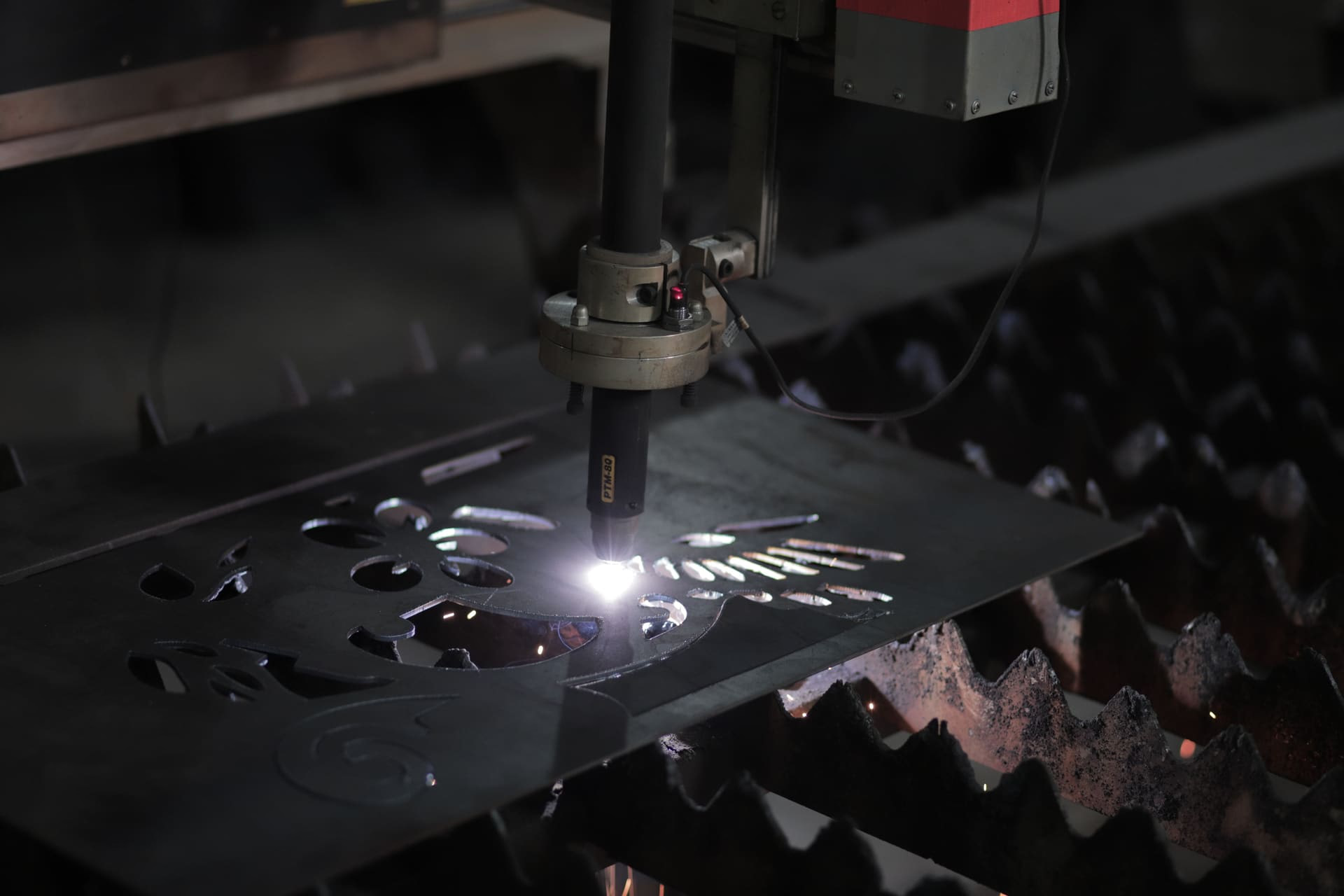
Selecting the thermal cutting process for steel plate
Laser, plasma or oxyfuel: how thickness, EN ISO 9013 quality class and downstream processing determine the cutting process and the cost of cutting to drawing.
News
Hardox 450 or 500: how the wear mechanism, the return on each hardness step and workshop processing determine the correct grade for each application.
Topics
Hardoxwear-resistant steelabrasion resistanceSSABoxyfuel cutting to drawing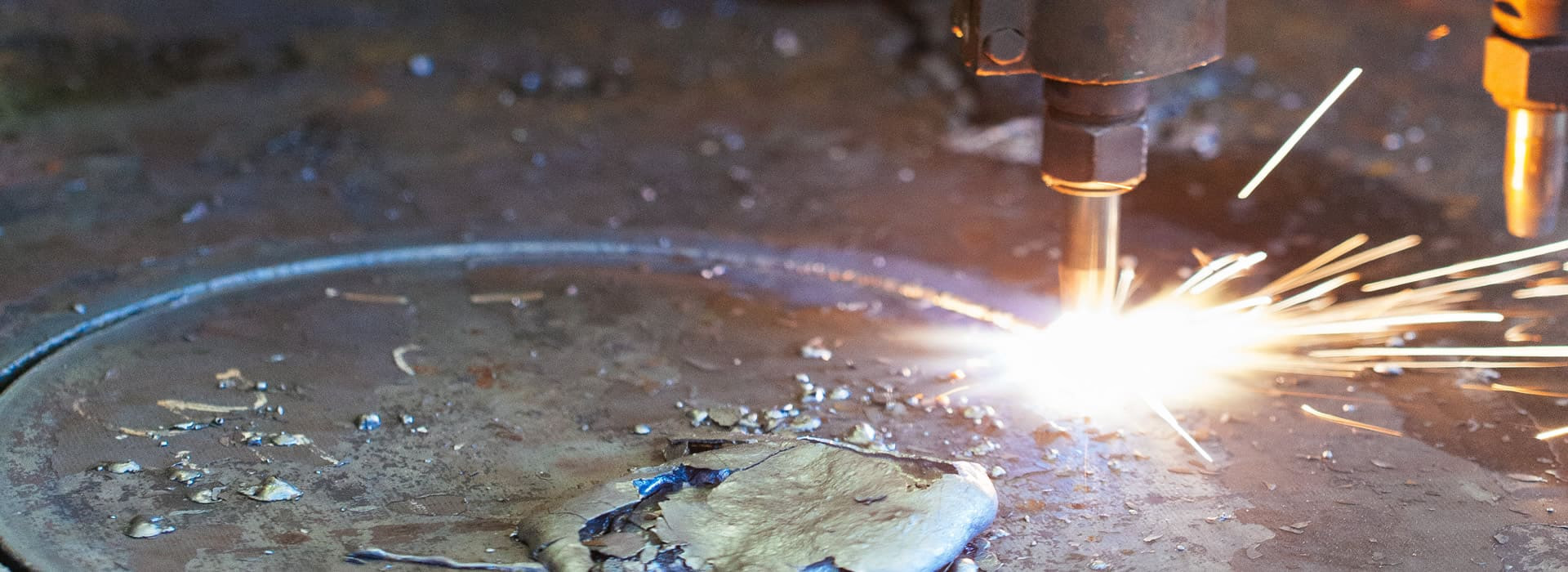
The choice between Hardox 450 and Hardox 500 depends on the wear mechanism acting on the component, not on the amount of wear it suffers. Where the damage comes from sliding abrasion, every point of hardness converts into service life in a nearly linear fashion. Where it comes from impact and gouging, beyond a certain threshold the plate cracks before it wears out, and the extra hardness produces no return.
Added to this is an effect that shows up in the workshop rather than in service: every step up in hardness widens the minimum bend radii, lowers the preheat threshold in welding and reduces the tolerance for process errors. A component in Hardox 500 costs more than one in Hardox 450 even at the same price per kilogram of plate.
This guide covers the selection parameters, the expected return on stepping up a grade and the implications for processing.
The most common misreading is to interpret the Brinell value as an index of structural strength. The two quantities are distinct: hardness measures the surface’s resistance to penetration, while yield strength marks the threshold beyond which the section deforms permanently.
Wear-resistant steels belong to the family of quenched and tempered grades, hardened and tempered to obtain a martensitic structure. Hardening is through-thickness, and the product guarantees assure at least 90% of the minimum surface hardness across the thickness. The component therefore keeps its properties even after wear has consumed the first millimetres — behaviour not obtainable with surface-only hardening.
| Grade | Hardness | Prevailing function | Typical use |
|---|---|---|---|
| Hardox 450 | 425-475 HBW | Wear resistance with residual structural properties | Components that resist abrasion and carry load |
| Hardox 500 | 470-530 HBW | Specialised wear resistance | Liners and consumable elements applied to a load-bearing structure |
| Equivalent wear-resistant steels | Various classes | Wear resistance without extended product guarantees | Heavy-duty work on non-critical components |
The 450 is the borderline case of the range, because it retains enough structural properties to act as a load-bearing element in many applications: tipper body walls, bucket structures, components that must both resist abrasion and carry load. From 500 upwards the function specialises, and the plate works as a liner applied to a structure whose load is carried by structural steel.
Ordering a wear-resistant grade for an element subject only to mechanical stress, with no exposure to abrasion, means paying for a performance the application does not use. In that case the correct reference is a high-yield structural steel, available among the quarto plates in S235, S275, S355 and Corten.
How the component wears out establishes which material property governs its life. The main mechanisms behave in opposite ways with respect to hardness.
| Mechanism | Typical operating condition | Evidence on the part at end of life | Governing property | Direction of choice |
|---|---|---|---|---|
| Sliding abrasion | Fine, hard material flowing over the surface | Uniform thinning of the thickness | Hardness | Step up a grade |
| Impact and gouging | Large blocks falling and digging | Cracks from corners, holes and welds, with plenty of residual thickness | Toughness | Step down a grade or revise the geometry |
| Flow erosion | Suspended particles, slurries, pneumatic conveying | Varies with the angle of incidence | Hardness or toughness depending on the angle | Assess case by case |
Sliding abrasion. Sand, crushed aggregates, slag, dry earth on hopper liners, tipper floors, chute plates, ducts for loose materials. The damage consists of the progressive removal of micro-volumes by particles harder than the steel, and the correlation between hardness and life is strong and essentially proportional. In these conditions the step up to 500 delivers as expected, and in particularly severe environments it makes sense to consider higher hardnesses.
Impact and gouging. Crusher feeds, screening grids, rock buckets, recycling plants with bulky, heterogeneous material. The prevailing damage is localised deformation with cracks propagating from the point of impact. The property governing life becomes toughness, which decreases as hardness increases. A plate that is too hard in a pure impact application breaks along the edges and around the holes before its sacrificial thickness is used up.
Erosion by particles in flow. Behaviour depends on the angle of incidence: at grazing incidence it approaches abrasion and rewards hardness; at perpendicular incidence it approaches impact and rewards toughness.
The operational criterion is to observe the replaced parts rather than the data sheets. A component that reaches end of life uniformly thinned indicates a need for more hardness. A component that reaches end of life cracked, with plenty of residual thickness, indicates the opposite — and replacing it with a harder grade makes the defect worse.
The data published by the producer provide an order of magnitude usable in economic assessment, referred to abrasion conditions.
| Increase over a 400 HBW wear-resistant steel | Indicative increase in service life |
|---|---|
| +50 HBW | 30-40% |
| +100 HBW | 80-100% |
The values should be read as a trend across comparable applications, not as a guarantee transferable to any operating condition.
The economic comparison is made up of three items, in increasing order of weight:
The calculation flips for components that reach end of life for reasons unrelated to wear: scrapping of the surrounding structure, machine reconfiguration, plant obsolescence. Extending life beyond that threshold produces no return.
Verifying the correct grade starts from examining the worn part and the actual operating conditions. The available formats and processing options are listed on the page for Hardox wear-resistant steel plates; for an assessment of a specific application, contact the Solsider technical office.
The difference between the grades shows up in the four operations a wear-resistant component goes through most often.
| Operation | Hardox 450 | Hardox 500 | Operational note |
|---|---|---|---|
| Minimum internal bend radius | about 3 times the thickness | about 4 times the thickness | Values refer to bending transverse to the rolling direction |
| Preheat in welding | Needed from higher combined thicknesses | Lower threshold | Depends on the combined thickness of the joint |
| Filler material | Low hydrogen, strength below the base material | Same criterion | Deformation concentrates in the weld bead rather than the surrounding metal |
| Thermal cutting | Oxyfuel with preheat control | Tighter control | Risk of cold cracking along the edge |
| Drilling | Reduced speeds, sustained feed | Dedicated tooling | Preferable to cut holes in the cutting cycle |
Bending. Beyond the minimum radius, two parameters change appreciably. The bending force grows in proportion to the yield strength, which on these steels far exceeds that of an S355. Springback is pronounced, which means the first bends of a series serve to calibrate the machine. Bending along the rolling direction requires wider radii than those shown in the table.
Welding. Both grades are weldable with ordinary processes. Heat input must be contained and interpass temperature kept low: excess heat locally tempers the martensitic structure and produces permanent softening of the heat-affected zone.
Thermal cutting. Oxyfuel is the usual process at these thicknesses. Selection criteria and consequences for the part are covered in the guide on selecting the thermal cutting process.
There is a third option, rarely considered, which in several applications beats both initial alternatives. Replacing a structural steel with a wear-resistant one makes it possible to reduce the thickness while maintaining or improving service life, and the material saved converts into payload.
| Thickness | Weight per square metre | Difference vs 10 mm |
|---|---|---|
| 10 mm | 78.5 kg | reference |
| 8 mm | 62.8 kg | -20% |
| 6 mm | 47.1 kg | -40% |
On a tipper body with a total surface of twenty square metres, moving from 10 to 8 mm frees over three hundred kilograms, which become additional payload on every trip for the entire life of the vehicle. The comparison on real geometries and thicknesses can be set up with the section weight calculator.
The preliminary check concerns the structural function. Reducing thickness lowers the section’s moment of inertia and therefore its stiffness — an effect the higher yield strength of the wear-resistant grade only partly compensates. On walls stiffened by profiles the operation is almost always practicable; on wide unrestrained panels it must be verified, because the limit encountered first is elastic deformation, not strength.
The market offers wear-resistant plates from various producers with comparable nominal hardnesses and lower prices. The parameter to compare is the contractual guarantees that accompany the material.
| Aspect | Branded material | Equivalent wear-resistant steel |
|---|---|---|
| Hardness through the thickness | Guaranteed at 90% of the minimum surface value | Not always declared |
| Dimensional tolerances | Tighter than the standard minimums | Per standard |
| Flatness and bending behaviour | Covered by guarantee | Varies between heats |
| Heat traceability | Complete | Depends on the supplier |
| Repeatability between supplies | High | To be verified |
The value of these guarantees lies in repeatability: every plate behaves like the previous one, and the bending and welding parameters tuned once remain valid. For a fabricator producing the same component in series, predictability matters more than the price per kilogram.
The equivalent wear-resistant steel remains the reasonable choice for one-off non-critical parts, for simple geometries without tight bends, for applications where the component is oversized relative to the expected wear. In these conditions the weight of the documented guarantee diminishes.
The summary criterion is the consequence of error. Where a crack in bending or softening in welding stops a production line or compromises an installed component, the material guarantee is the cheapest item of the whole operation. Where the error costs one plate, the calculation may point elsewhere.
For hardnesses, formats and finishing operations such as bevelling, bending and rolling, the reference is the services page, or direct contact with the technical office.
Laser, plasma or oxyfuel: how thickness, EN ISO 9013 quality class and downstream processing determine the cutting process and the cost of cutting to drawing.
Why calculated weight and delivered weight differ even on compliant supplies: calculation basis, tolerances by product family and the verification procedure.
Contact our technical office for an assessment of your supply or processing needs. Guaranteed response within 24 hours.