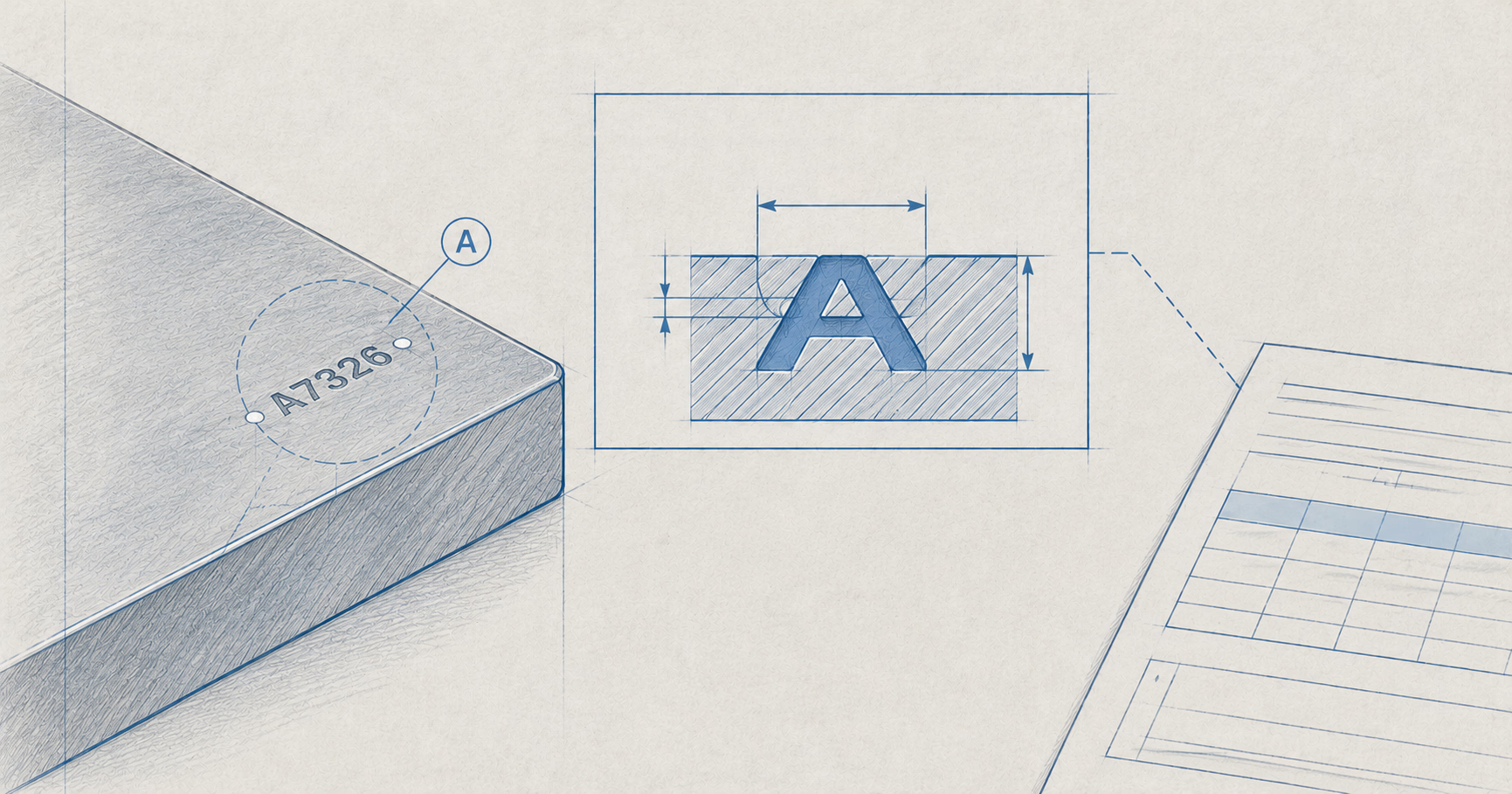
Genuine Hardox: matching the plate ID to the 3.1 certificate
Red primer proves little: Hardox is genuine when the ID stamped on the plate matches SSAB’s 3.1 certificate, a link that cutting to drawing breaks
News
T1 is a structural steel, Hardox and XAR are brands, and NM400 is a Chinese standard grade. Guarantees, certificates and 2026 EU import rules compared.
Topics
hardox
Hardox, XAR and NM400 are quenched wear-resistant plates with similar nominal hardness, and the same grade numbers recur from one name to the next. T1, by contrast, is a high-yield structural steel that often appears alongside them on price lists.
Hardox is a brand of the Swedish steel group SSAB; XAR belongs to thyssenkrupp, which used to roll it in Duisburg. NM400 is a grade in a Chinese national standard: it is not tied to any brand and can be bought from many mills.
On top of that, from 2026, EU rules on imported steel reduce duty-free volumes and require proof of the country where the steel was melted. So when hardness is equal, comparing these plates also comes down to the manufacturer’s written guarantees and the mill named on the certificate.
The name comes from T-1, the trademark under which U.S. Steel introduced a quenched and tempered alloy steel for structures, cranes and heavy machinery. Its reference is the American standard ASTM A514, which sets a minimum yield strength of 690 MPa for thicknesses up to 65 mm.
On Italian price lists, T1 often refers to plate in the European grade S690QL, defined by EN 10025-6. In the designation, S stands for structural steel, 690 for the minimum yield strength in MPa, Q for quenched and tempered, and L for guaranteed toughness at low temperature.
The company behind Hardox sells this grade under a separate brand from its wear plate: Strenx 700 E. EN 10025-6 sets yield strength, tensile strength and toughness, and leaves hardness unspecified. The American standard prescribes it only for thicknesses up to 20 mm, at 235–293 HBW.
Where material slides across the plate, service life depends largely on hardness, and the 235–293 HBW of T-1 falls well short of the 370–430 HBW of 400-grade wear plate. On S690QL, hardness appears on the certificate only if the customer asks for it to be measured.
A request for quotation that just says ‘T1’ is therefore ambiguous, so it is best to specify the grade (S690QL to EN 10025-6, for example) or the hardness required. A single part can also combine different requirements, as in a bucket, where the structure and mounting brackets carry the load while the cutting edge, bottom and side plates take the wear. The material for each zone is chosen on the drawing.
In all three names, 400 stands for the same nominal Brinell hardness, and the stated ranges almost coincide. Behind that number, though, lie different documents: a manufacturer’s data sheet for Hardox 400 and XAR 400, a national standard for NM400, as the table summarises.
| Hardox 400 | XAR 400 | NM400 | |
|---|---|---|---|
| Type of name | Manufacturer’s brand | Manufacturer’s brand | Grade in the Chinese standard GB/T 24186 |
| Where it is made | Sweden, Finland and the United States | Duisburg, until the heavy plate mill closed in 2021 | Various Chinese mills |
| Hardness | 370–430 HBW | 370–430 HBW | 360–420, 360–440 or 370–430 HBW, depending on the source |
| Thickness | 2–130 mm | 4–100 mm | Varies by mill |
| Where the values are stated | Manufacturer’s data sheet and written guarantees | 2017 brochure, with guarantees only by written agreement | The standard and the batch certificate |
XAR in medium and heavy thicknesses came from the heavy plate mill in Duisburg-Hüttenheim, which fulfilled its last orders on 18 March 2021. Wear-resistant grades made from hot strip are still in the catalogue, now 4 to 8 mm thick and sold under a different name. A quote for thick XAR plate should be checked against its certificate, which shows where and when the batch was produced.
The letters NM come from the Chinese nàimó, ‘wear-resistant’, and the grade is defined by GB/T 24186, revised in 2022. Each mill makes it with its own chemistry within the limits of the standard, and the stated values vary from one seller to the next. For NM400, the reference remains the batch certificate, showing the mill’s name and the measured hardness.
A data sheet separates guaranteed values, which the manufacturer commits to meeting on every delivery, from typical values, which describe average production. The written guarantees for Hardox grades also cover flatness, bending radii and thickness tolerances.
The 2017 XAR brochure states that its contents are descriptive and that guarantees apply only if agreed in writing. For NM400, the mill is accountable for the requirements of GB/T 24186; everything else depends on the supply contract.
The mill test certificate shows the mill, heat number, chemical analysis and the values measured on the batch, linking each plate to its origin. From 2026, the same document is also needed at customs for imported plate. For material supplied by Solsider, certificates and declarations of conformity can be requested from the quality department.
On 1 July 2026, Regulation (EU) 2026/1384 replaced the steel safeguard measure in force since 2019. According to the European Commission, duty-free import volumes fall by around 47% compared with 2024, and the out-of-quota duty rises to 50%.
The categories covered include quarto plate and hot-rolled flat products, alloy grades included: the families wear plate belongs to. Quotas are allocated by country to the main suppliers and managed quarterly; once a quota is exhausted, imports pay the full duty. The cost of the same batch therefore also depends on the date it arrives at customs.
From 1 October 2026, Implementing Regulation (EU) 2026/1963 requires importers to prove where the steel was melted and poured. The primary proof is the mill test certificate stating the heat number and the country of melt and pour, and other documents are accepted until 30 September 2027. Without adequate proof, customs rejects the import, even if the country’s quota is still open.
Since 1 January 2026, imported iron and steel have been in the definitive period of the Carbon Border Adjustment Mechanism (CBAM), which puts a price on the carbon emitted in producing them. Anyone importing more than 50 tonnes a year must be an authorised CBAM declarant and submit their first declaration by 30 September 2027.
These rules apply to plate produced outside the EU, such as Chinese NM400 or any brand of wear plate rolled in a non-EU country. Hardox from the Swedish and Finnish mills is of EU origin, while US-made Hardox is subject to the import rules. The mill that produced the batch should therefore be confirmed as early as the quotation stage, because duty, paperwork and customs clearance times all depend on it.
The choice starts from the part’s role and ends at cost per operating hour, through data known only to whoever runs the plant or designs the machine. There are four, and each one narrows the field.
With this information, Solsider’s technical department compares the alternatives on the same part, from a drawing or from measurements, using the plant’s actual figures. The assessment stays tied to the component, because the same grade can be the right choice for one zone and unsuitable for the one next to it.
In short, choose the material according to the part’s role and the values guaranteed in writing, and check the mill and origin of the batch on the certificate.
Hardox wear-resistant steel plate is available in standard sizes or oxy-fuel cut to size from customer drawings. For an assessment, send the drawing, the current material and the service life achieved to the technical department, which replies within 24 working hours.
Is T1 a wear-resistant steel?
In its standard form it is a structural steel, chosen for its yield strength. In the United States, T-1 was also offered in abrasion-resisting versions with minimum hardnesses of 321, 340 or 360 HBW, below the guaranteed range of Hardox 400.
What is the difference between S690QL and S690QL1?
The lowest temperature at which toughness is guaranteed: −40 °C for QL and −60 °C for QL1. In the Hardox manufacturer’s catalogue, the two grades correspond to Strenx 700 in its E and F versions.
Is there an equivalent to Hardox 450 or 500?
Other manufacturers and the Chinese standard include grades with the same nominal hardness, to be compared as with the 400: on guaranteed range, thickness and certificate. The guaranteed values for Hardox 450 and 500 are listed on the Hardox product page.
Who pays duty and CBAM costs on plate bought in Italy?
The obligations fall on whoever imports the goods and declares them at customs, usually the distributor or its supplier. For buyers of customs-cleared plate from an Italian warehouse, they sit upstream in the supply chain, and their cost is built into the purchase price.
Red primer proves little: Hardox is genuine when the ID stamped on the plate matches SSAB’s 3.1 certificate, a link that cutting to drawing breaks
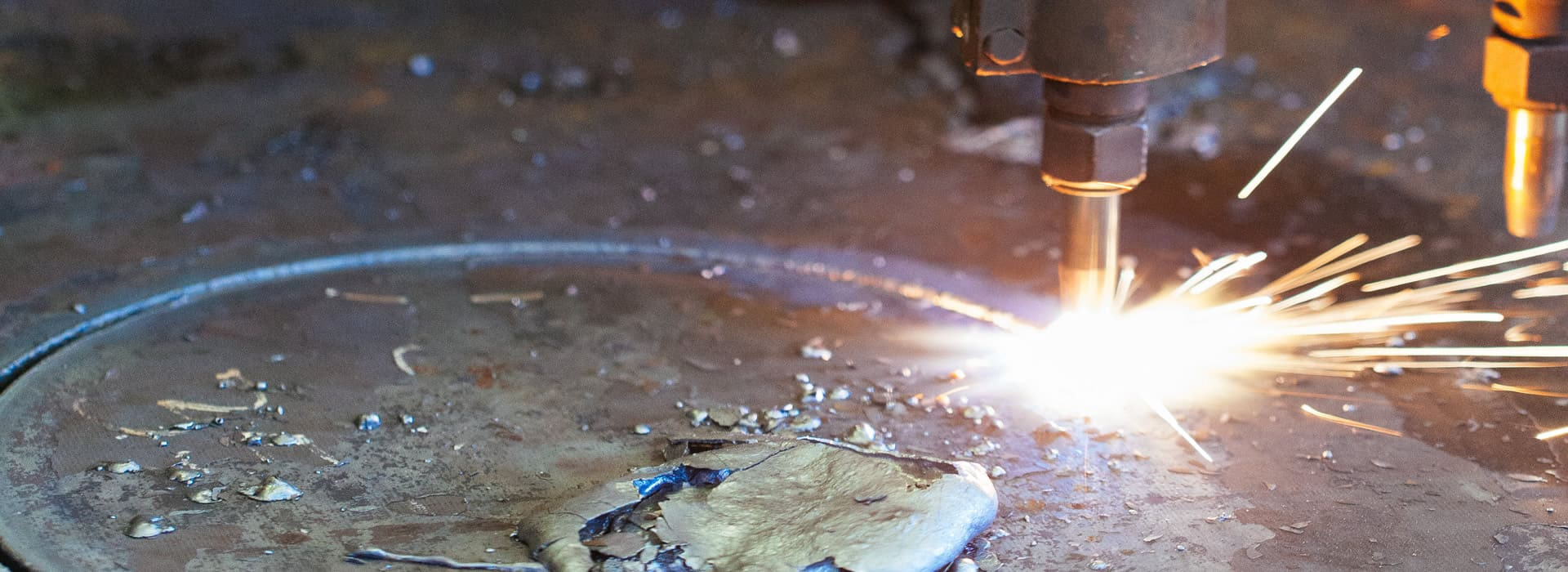
Hardox 450 or 500: how the wear mechanism, the return on each hardness step and workshop processing determine the correct grade for each application.
Contact our technical office for an assessment of your supply or processing needs. Guaranteed response within 24 hours.