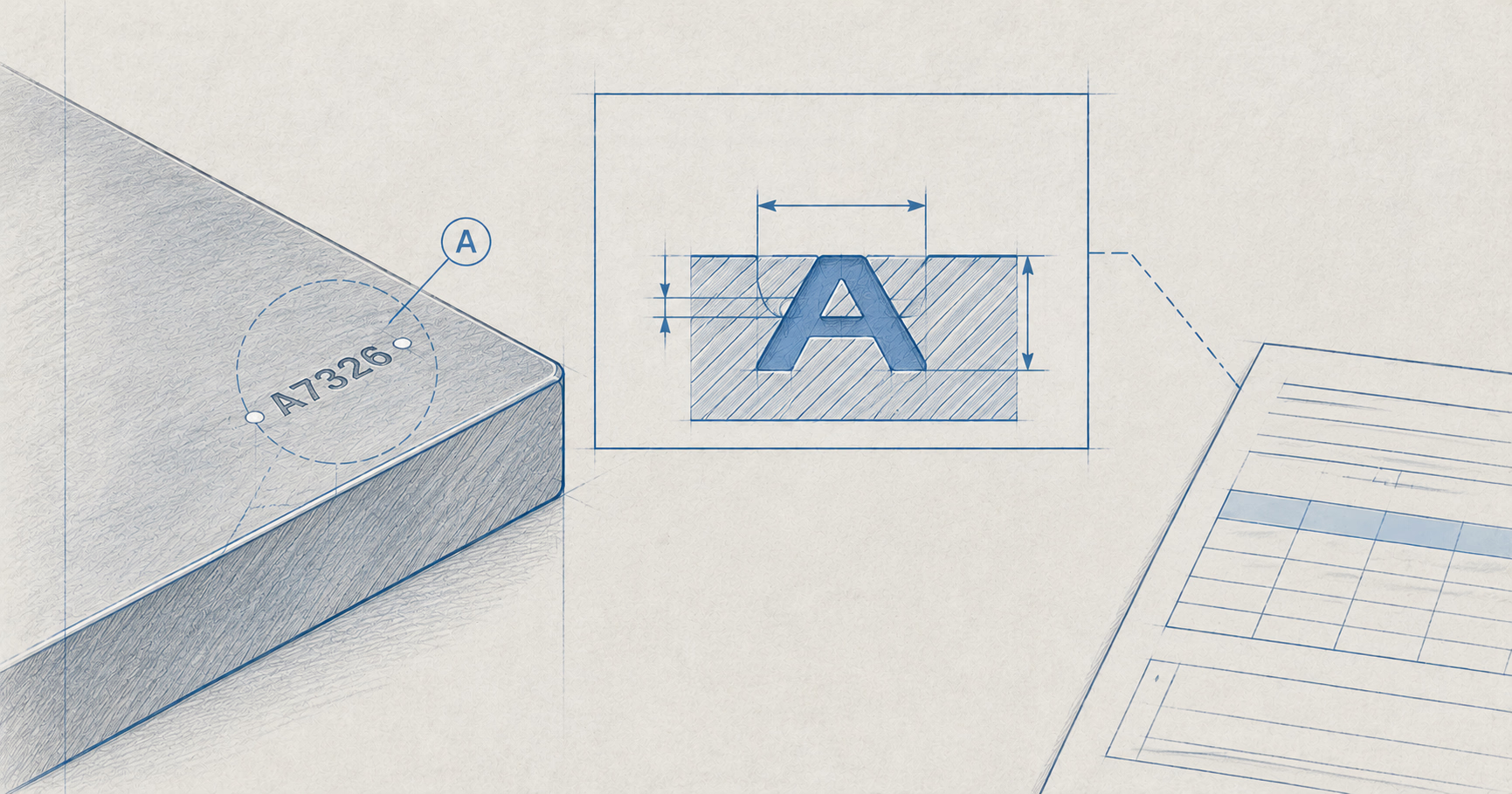
Genuine Hardox: matching the plate ID to the 3.1 certificate
Red primer proves little: Hardox is genuine when the ID stamped on the plate matches SSAB’s 3.1 certificate, a link that cutting to drawing breaks
News
Hardox is SSAB's wear plate, hard right through to the core. The grade number is its nominal Brinell hardness, not a quality rating.
Topics
hardoxwear-resistant steel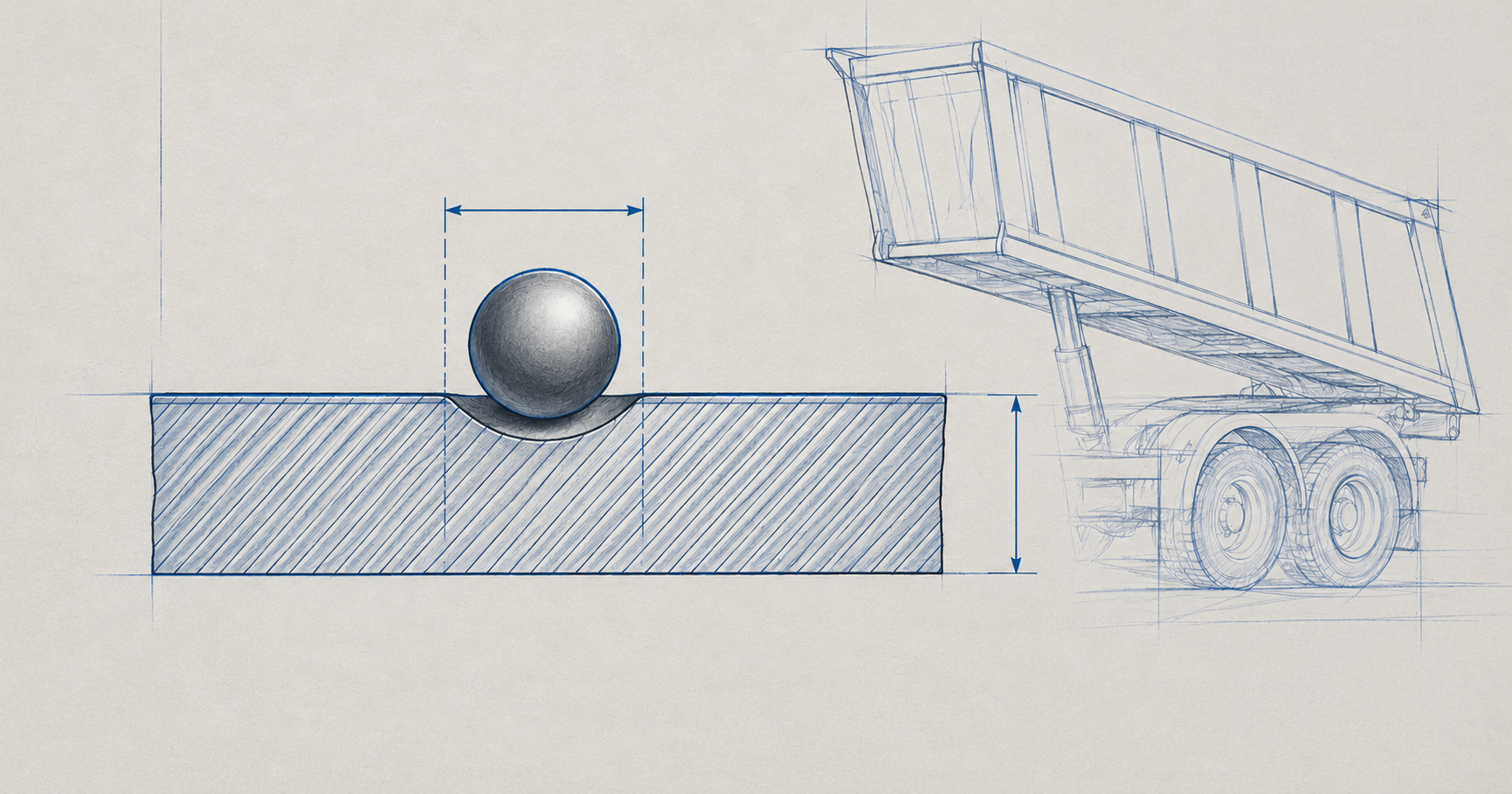
Hardox is the wear plate made by the Swedish steel group SSAB, a low-alloy steel that is quenched at the mill and stays hard through its full thickness. It wears more slowly than structural steel, yet it can be welded and bent with standard workshop processes. The number after the name indicates the nominal Brinell hardness. Around that value a range is guaranteed, which for Hardox 450 runs from 425 to 475 HBW up to 80 mm thick.
This guide explains where that hardness comes from, how to read the grades, how Hardox plate behaves in the workshop and when another steel is the better choice.
Five facts are enough to frame the material before going into detail.
| Feature | Value |
|---|---|
| Manufacturer | SSAB, with mills in Sweden, Finland and the United States |
| Steel type | Low-alloy, quenched at the mill, through-hardened |
| Hardness | From 310–370 HBW (HiTuf) to a nominal 60 HRC (Extreme) |
| Thickness | From 0.8 to 160 mm, depending on grade and product form |
| Temperature limit | 250 °C for 400, 450, 500 and 500 Tuf, above which the as-delivered properties are lost; 150 °C for Extreme and for Hardox 600 sheet |
Anyone who pictures Hardox as a surface-hardened plate misunderstands where its hardness comes from: it is produced by quenching at the mill. Quenching is very rapid cooling of the plate, followed where needed by tempering, which improves toughness. This treatment gives the plate its through-hardness, which sets Hardox apart from hardfaced plates, where the resistant layer sits only on the surface. The manufacturer guarantees at least 90% of the minimum surface hardness at the core, so the plate stays effective even after wear has removed the first few millimetres.
The base material is a low-alloy steel with a lean chemistry, in which carbon does not exceed 0.26% in the 450 grade. Chromium, nickel, molybdenum and boron are present in small amounts.
The product has half a century of history behind it, going back to the first grade, launched in 1974 at the Oxelösund mill as OX AR 360 S and later renamed Hardox 400. Today Hardox is a registered trademark of the manufacturer and identifies only plate from the group’s mills in Sweden, Finland and the United States.
The grade number invites a misreading: taking it as an overall quality rating. It expresses only the nominal Brinell hardness, while toughness and workability can differ between two grades with the same number, such as Hardox 500 and 500 Tuf. Brinell hardness is measured by pressing a tungsten carbide ball into the plate and measuring the diameter of the indentation, according to EN ISO 6506-1.
The table gives the guaranteed hardness range, the thicknesses produced and the main use of each grade, from HiTuf, the least hard, to Extreme, at the top of the scale.
| Grade | Hardness | Thicknesses produced (mm) | Main use |
|---|---|---|---|
| Hardox 400 | 370–430 HBW | 2–130 | Moderate wear, with good bendability and weldability |
| Hardox 450 | 425–475 HBW | 0.8–160 | Wear combined with a structural role (tipper bodies and buckets) |
| Hardox 500 | 470–530 HBW | 2–103 | Heavy wear (liner plates, screens, wear bars) |
| Hardox 500 Tuf | 475–505 HBW | 3–38.1 | The hardness of 500 with the workability of 450 (tipper bodies, buckets, containers) |
| Hardox 550 | 525–575 HBW | 8–65 | Crusher and chute liners, recycling hammers |
| Hardox 600 | 570–640 HBW | 2.5–65 | Hopper and mill liners, crusher parts |
| Hardox Extreme | 60 HRC nominal (650–700 HBW typical) | 8–19 | Extreme abrasion (shredder knives, glass recycling) |
| Hardox HiTuf | 310–370 HBW | 40–160 | Heavy plate with guaranteed toughness (bucket cutting edges, rotors) |
| Hardox HiAce | 425–475 HBW | 3–100 | Wear with corrosion or heat (waste, paper mills, tipper bodies) |
The ranges are guaranteed for every grade except Extreme, for which typical values are given. In heavy thicknesses some ranges widen, especially for 450, which drops to 410–475 HBW above 80 mm and to 390–475 HBW above 103 mm. The 500, by contrast, moves to 450–540 HBW above just 32 mm, and the 600 to 550–640 HBW above 51 mm. The same steel is also produced as round bar, with diameters from 40 to 160 mm, and as tube with outside diameters from 76.1 to 219.1 mm.
A harder plate outlasts a softer one only as long as abrasion is what wears it. Sand, crushed stone and scrap remove less metal the higher the surface hardness, whereas impact calls for toughness, the ability to absorb energy without cracking. The two properties tend to pull in opposite directions, and where the load consists mainly of blows, a plate that is too hard breaks before it wears out.
Toughness is measured with the Charpy test, in which a pendulum breaks a notched specimen and the energy absorbed in the fracture is recorded in joules. In the manufacturer’s data sheets, Hardox 450 typically absorbs 50 J at −40 °C, while 500 stops at 37 J at the same temperature. The step up in hardness between the two grades therefore comes at the cost of a smaller margin against impact.
Where abrasion and impact act together, as in tipper bodies and buckets, a grade with guaranteed minimum toughness is the better choice. For 500 Tuf the minimum is 27 J at −20 °C in plates from 8.1 to 38.1 mm, and for HiTuf it is 40 J at −40 °C. How to choose between 450 and 500 is covered in the article on selecting the hardness grade in Hardox wear-resistant steels.
In the workshop, Hardox is processed with the same methods as structural steel. What changes are the margins, because temperature limits and bending radii become stricter as hardness increases.
Thermal cutting
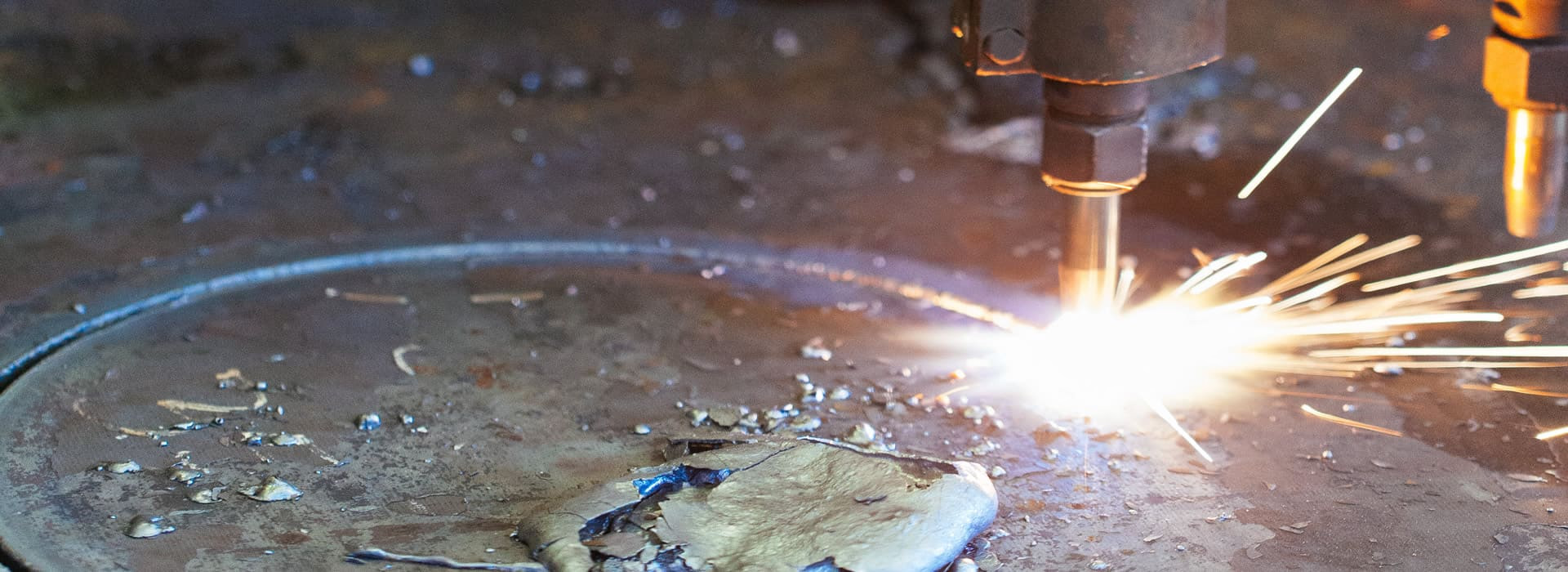
Hardox can be cut by laser, plasma or oxy-fuel, and the heat of the process tempers the material along the edge, softening a strip a few millimetres wide. On heavy plate, controlled preheating is added to prevent cold cracking. The choice between the three depends on the thickness and geometry of the part, as explained in the article on selecting the thermal cutting process for steel plate.
Welding
It can be welded with common processes, from MAG wire and covered electrodes to submerged arc, including joints between Hardox and structural steel. The precautions the manufacturer recommends concern mainly hydrogen and heat. For filler metal, the guideline is low hydrogen content, up to 5 ml per 100 g of deposited weld metal.
Preheating depends on grade and thickness, and is set by the thickest plate in the joint and, when different steels are joined, by the more demanding one. The Welding of Hardox guide recommends a maximum interpass temperature of 225 °C for almost all grades, 300 °C for HiTuf and 100 °C for Extreme.
Bending
It is bent cold, within the minimum radii guaranteed by the manufacturer, which increase with hardness and thickness. On 10 mm plate, with the bend line perpendicular to the rolling direction, the punch radius must not go below 30 mm for Hardox 400. The minimum rises to 35 mm for 450 and to 40 mm for 500. Hot bending is ruled out, because above 250 °C the plate loses its as-delivered properties.
Hardox is used wherever a component wears from the sliding or impact of bulk material such as soil, rock, scrap and waste.
Standard Hardox performs best when wear is the only problem to solve and service conditions leave the effects of quenching intact. If either condition fails, as in the four recurring situations in the table, another solution is needed.
| Condition | Effect on the material | Alternative |
|---|---|---|
| Service above 250 °C (150 °C for Extreme and for Hardox 600 sheet) | The as-delivered properties are lost | Hardox HiAce, which according to the manufacturer generally retains at least 90% of its minimum hardness up to 400 °C |
| Acidic or wet environments | Standard Hardox is not stainless, and corrosion compounds the wear | Hardox HiAce, developed for combined corrosion and wear |
| Hot forming or heat treatment in the workshop | Not intended, because the hardness comes from quenching at the mill | Cold bending within the guaranteed radii |
| Components not subject to wear | You pay for hardness that does no work | Structural steel, for example S355 |
Precisely because Hardox is a brand, a wear plate from another manufacturer is a different product, with its own properties and guarantees, even when its nominal hardness is similar. The comparison with XAR 400 and NM400 at the same hardness is in the article on how Hardox 400 compares with its equivalents. For Hardox, the manufacturer guarantees in writing the hardness at the surface and at the core, flatness and minimum bending radii. Thickness tolerances are also covered by the guarantee and are tighter than those of EN 10029 Class A, up to 80 mm. Machine builders also have access to the Hardox In My Body programme, through which the manufacturer certifies equipment that meets its design and fabrication specifications.
Solsider, based in Montebelluna in the province of Treviso, Italy, has been trading steel since 1927, with daily deliveries across Veneto, Friuli, eastern Lombardy and Trentino. Hardox is supplied in standard plate sizes and oxy-fuel cut to size, with stock held for quick-turnaround jobs.
From DXF or DWG drawings, Hardox plates are oxy-fuel cut, with nesting that reduces scrap. Flame bevelling, bending and rolling complete the part (cutting and processing services). Material certificates and declarations of conformity are available on request from the quality department (certifications).
In short, start from the worn part and its operating conditions, and let the type of wear decide the grade and the load and expected service life decide the thickness. Grades and processing are described on the Hardox wear-resistant steel plate page. For an assessment from a drawing or measurements, you can write to our technical department, which replies within 24 working hours, or call +39 0423 22603.
Is there a Hardox 700?
No, there is no grade by that name in the manufacturer’s current range. The hardest is Hardox Extreme, with a nominal 60 HRC and typical values of 650–700 HBW, produced in thicknesses from 8 to 19 mm.
Is Hardox a stainless steel?
No. It is a low-alloy steel without the corrosion resistance of a stainless grade. In 450, chromium does not exceed 1.40%, while the threshold that defines a stainless steel is 10.5%. Where corrosion and wear act together, Hardox HiAce is used.
How much does a Hardox plate weigh?
The theoretical weight is calculated as for carbon steels, using the conventional density of 7.85 kg/dm³. Each millimetre of thickness therefore corresponds to 7.85 kg/m², and a 10 mm plate weighs 78.5 kg/m². For other sizes and thicknesses you can use the weight calculator.
Who makes Hardox and where does the name come from?
Only SSAB makes it, at the group’s mills in Sweden, Finland and the United States. The name, registered in 1983, refers to the material’s hardness and to Oxelösund, the Swedish town where the first grade was born in 1974.
Hardox 450 or 500: which is better?
In pure abrasion 500 performs better, while 450 leaves more margin where impact, tight bends or welding come into play. The detailed comparison, with worked examples, is in the article Selecting the hardness grade in Hardox wear-resistant steels.
Red primer proves little: Hardox is genuine when the ID stamped on the plate matches SSAB’s 3.1 certificate, a link that cutting to drawing breaks
Hardox 450 or 500: how the wear mechanism, the return on each hardness step and workshop processing determine the correct grade for each application.
Contact our technical office for an assessment of your supply or processing needs. Guaranteed response within 24 hours.